The Moisturizer’s Manifesto
This briefing was supposed to cover “routine personal maintenance”, which is usually code for something dull enough to file while half‑asleep. Instead, several departments panicked, one agency pretended not to exist, and a memo spontaneously reclassified itself. All this over an everyday habit most citizens perform while thinking about absolutely nothing.
The briefing began with the dermatologist clearing their throat in the way people do when they’re about to redefine a word you thought you understood. Something about the skin, they said, had been misfiled for decades. Not incorrect, exactly – just placed in the wrong category, with consequences no one had fully appreciated until now.
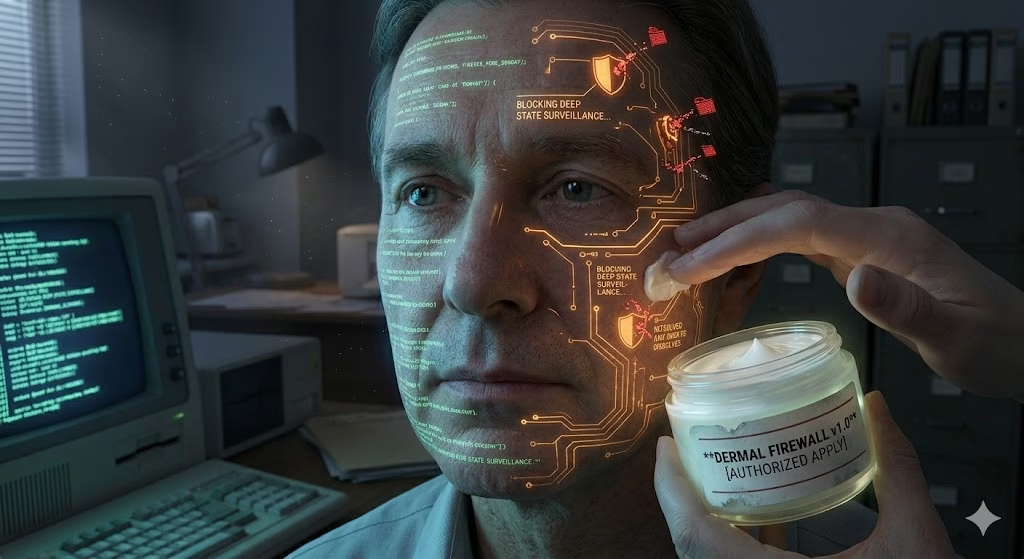
The leaked document—titled, with unnerving confidence, The Moisturizer’s Manifesto—outlined a simple premise: every dry patch is a breach, every flake a data leak, every unhydrated elbow a potential backdoor for subliminal governance updates. According to the Manifesto, the so‑called “skin barrier” is a distributed security perimeter, constantly negotiating with the environment about what gets in, what stays out, and which particles are granted temporary visitor visas in the name of “glow”. Moisturizer, in this schema, is not self‑care; it is a firmware update disguised as a spa day.
The Department of Epidermal Security, previously a sleepy sub‑office concerned with sunscreen compliance and rogue exfoliants, suddenly found itself at the centre of a geopolitical moisturization crisis. Serums were reclassified as “advanced encryption layers”, toners as “pre‑handshake protocols”, and occlusive balms as “emergency lockdown procedures”. Citizens were advised to apply their creams in small, circular motions, both to improve absorption and to symbolically affirm their participation in the ongoing defence of the dermal perimeter. Failure to moisturize, the memo suggested, might constitute passive collaboration with hostile atmospheric forces.
Naturally, resistance formed almost immediately. A loose coalition of anti‑lotion dissidents argued that dryness was a form of sovereignty, that flakiness represented the body’s right to broadcast unfiltered signals into the ether. They claimed that every layer of moisturizer was another layer of state interference, a glossy sheen of compliance. In response, the Manifesto’s authors released an addendum clarifying that hydration was not mandatory, merely “strongly recommended for those wishing to avoid unauthorized ideological chapping”. The phrase did not help.
Meanwhile, the skincare industry pivoted with breathtaking speed. Moisturizers were repackaged as “Patriotic Barrier Reinforcement Systems”, complete with threat‑level indicators and limited‑edition tubes bearing the insignia of various agencies. Influencers posted tutorials on “Hardening Your Surface Against Soft Power”, demonstrating how to layer serums for maximum resilience against both pollution and propaganda. Somewhere between the third and fourth step, it became impossible to tell whether anyone was still talking about skin, or if the entire nation had simply agreed to conduct its political discourse via texture metaphors.
In the end, the committee concluded that the truth lay, as it so often does, in the fine print. The Moisturizer’s Manifesto was neither pure conspiracy nor pure marketing; it was a reminder that the line between “personal care” and “infrastructure maintenance” had quietly dissolved. Our skin, it seemed, had always been a firewall. We were only now reading the changelog.
Apply generously, they advised, to all exposed areas of belief.

Harry is a satirist in remission who now moonlights as a metaphysical desk jockey. He specialises in cosmic admin, recursive nonsense, and the occasional algorithmic incident report. One poem he wrote still hasn’t stopped, and several readers claim it whispers back during thunderstorms.