Lunar Mining: The New Gold Rush
Humanity’s renewed push to mine the Moon for Rare Earth Elements is framed as a triumph of environmental responsibility: a bold plan to “save” Earth by relocating the damage to the only other celestial body within commuting distance. It all sounded perfectly reasonable until the paperwork started arriving from entities no feasibility study had ever mentioned.
The early missions were textbook examples of scientific optimism. Rigs unfolded, drills hummed, and the first scoops of regolith were celebrated as if they were the opening notes of a greener future. The Moon, silent and unzoned, was assumed to be a passive participant in humanity’s latest industrial enthusiasm. No one expected resistance from a body that had never once objected to being photographed without consent.
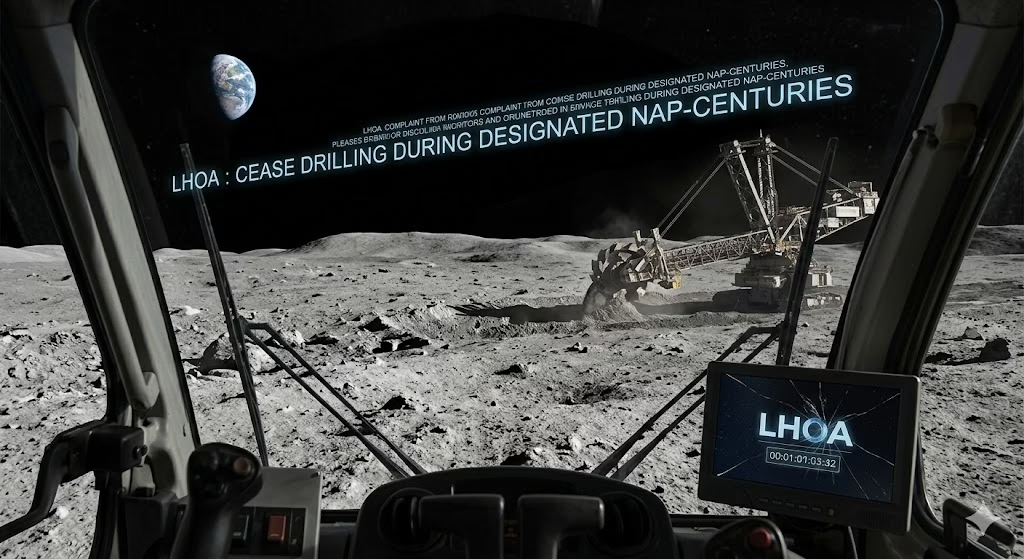
But the optimism cracked when the complaints began – formal, holographic, and written in a script that translated roughly to: “Cease drilling during designated nap‑centuries.” The discovery of the Lunar Homeowners Association, an ancient bureaucratic organism etched into basalt, forced mission control to confront an uncomfortable truth: the Moon had rules, and we were already breaking several of them with our “excessive clanking.” Craters rearranged themselves into passive‑aggressive messages visible from orbit, including the devastatingly simple WE WERE HERE FIRST.
Diplomats scrambled to negotiate quiet hours, economists attempted to model “interplanetary strata fees,” and one unfortunate intern was tasked with ensuring the phrase “Lunar Karens” never appeared in official documentation. Mediation proved difficult, as the Lunar Homeowners Association (LHOA) insisted all meetings occur during “mutually acceptable non‑nap intervals,” which – after conversion – turned out to be three seconds every eleven years. Even the dust motes were voting now, and they were not on our side.
By the time the LHOA introduced a clause requiring all future extraction to be approved by a two‑thirds majority of resident entities – including shadows, echoes, and the faint memory of an astronaut who once swore into his helmet – the dream of a lunar gold rush had evaporated. We set out to mine the Moon, only to discover it already had a body‑corporate with strong opinions and infinite patience.
Perhaps the rarest element in the solar system is simply the ability to stop annoying the neighbours.

Harry is a satirist in remission who now moonlights as a metaphysical desk jockey. He specialises in cosmic admin, recursive nonsense, and the occasional algorithmic incident report. One poem he wrote still hasn’t stopped, and several readers claim it whispers back during thunderstorms.